01
October 22, 2026
Merchant of Record: DIY vs Outsourcing. What does improvisation really cost you?

T-Data’s speech at Ecommerce Italia: “Going abroad to finance growth – How internationalisation has been the secret to investment over the last 20 years”
22/04/2026 – Spazio Monte Rosa 91, Milan
Ecommerce Italia represents one of the main reference events for the electronic commerce sector. This year's edition focuses on the integration of technology, artificial intelligence, and the optimisation of operational processes to meet the demands of an exacting market.
T-Data is actively participating in the event, sharing the experience gained in managing complexity for brands operating on an international scale.
The presentation delivered by Marta Bulbarella (Sales Manager) is part of the strategic panel "Going abroad to finance growth – How internationalisation has been the secret to investment over the last 20 years". Within this analytical scenario, T-Data’s contribution focuses on "Focus on robotic logistics & marketplace integration".
In the following paragraphs, we analyse the key points emerged during the speech: from the impact of robotic automation on business scalability to the strategies needed to govern multi-channel operations and protect margins on international marketplaces.

The supply chain today is a complex system where efficiency has become an implicit requirement. Marketplaces have set standards that customers now consider the norm: evening orders, immediate dispatch, and frictionless returns. In this scenario, the disruption of a single step compromises the entire sale.
To sustain such rhythms, a data-driven industrial approach is required, allowing for the prediction of flows over the following 72 hours and the identification of the most effective outbound logistics node. This operational model is based on three fundamental pillars:
Automation and Scalability: when volumes rise from one thousand to ten thousand daily orders in a week, the human component reaches its physical limit. The adoption of robotic systems operating 24/7 is the minimum requirement to manage demand peaks without saturating the structure.
Carrier Orchestration: warehouse efficiency is futile without distribution governance. Current logic moves beyond choosing the cheapest courier in favour of dynamic routing with multiple active players, ensuring service continuity even in the event of a single provider's failure.
Advanced Service Logic: operational choices define brand perception. Introducing processes such as customer refunds while the return is still in transit aligns the company with the parameters of the modern consumer, who does not accept the technical lead times of traditional logistics.
Governing the entire chain means transforming logistics from a cost centre into a strategic lever for customer satisfaction.
There are very clear operational and economic indicators that show when an in-house model has reached saturation. Relying on a structured partner allows for the protection of business integrity across every sales channel, ensuring that growth is fluid and free of bottlenecks.
According to T-Data’s know-how, the signals indicating the need to evolve towards a more scalable model are:
Operational Risk and Penalties: on marketplaces, dynamic rules do not allow for exceptions. Failure to meet shipping times carries the concrete risk of account suspension. Similarly, on a proprietary store, a picking error damages customer trust and compromises future sales.
Multi-channel Saturation: selling simultaneously across different channels and in multiple countries requires a step change in processes. Without real-time stock synchronisation, the risk of "overselling" becomes a constant difficulty to manage.
Resilience during Demand Peaks: if events like Black Friday throw logistics into crisis, the current structure is limiting turnover instead of supporting it.
Indirect Costs and Cross-Border issues: in-house logistics can hide heavy costs related to manual error management. Furthermore, managing returns from different countries requires customs expertise and carrier agreements that are difficult to optimise with internal resources.
The integration of the Merchant of Record (MoR) allows for the delegation of legal responsibility for invoicing and duties to a specialist, making entry into new territories immediate.
It is often thought that outsourcing is a subsequent step, to be taken only after reaching a large scale. In reality, there is no single path. Starting immediately with a structured partner is the move that secures the business from day one.
T-Data acts as the director of this growth through the operational management of marketplaces and proprietary sites, handling catalogue implementation and the synchronisation of sales flows. The added value lies in the ability to balance stock between centralised logistics and that of individual platforms, eliminating the anxiety of overselling which can lead to account closures.
According to our know-how, while leaving the brand to define pricing strategies, operations must follow differentiated paths to maximise results:
"Hero" Products and Marketplace Logistics: it is advisable to allocate only high-rotation items to the platforms' proprietary logistics infrastructures (such as Amazon FBA). These products benefit from maximum visibility and specific loyalty programmes, whilst following a logistics flow external to T-Data warehouses.
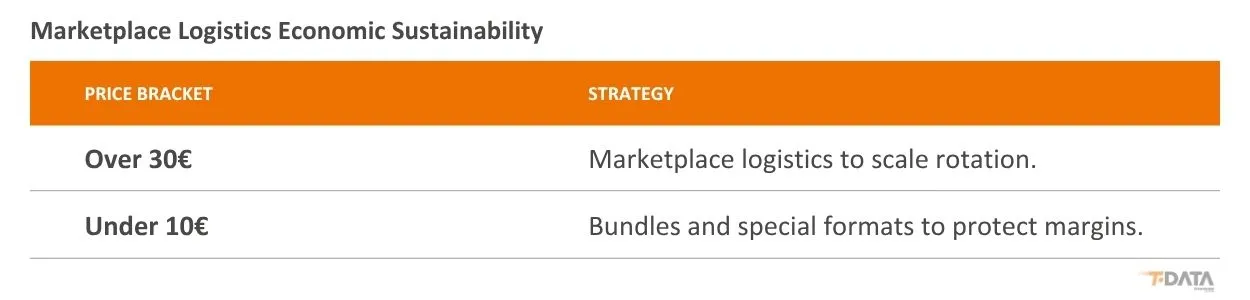
Operational Efficiency and Internationalisation: using marketplace logistics proves profitable for products around 30 euros. For lower price brackets, we support the brand with the management of bundles and special formats to increase the average order value and protect margins. In this vision, the marketplace acts as a gateway for new customer acquisition, while the e-commerce store remains the heart of the brand identity. Furthermore, the integration of the Merchant of Record transforms fiscal complexity into a fluid process, removing barriers to entry in foreign markets.
Long Tail and T-Data Logistics: our centralised logistics is the ideal solution for managing the entire catalogue of proprietary stores and the "long tail" of marketplaces. This asset becomes fundamental for maintaining a presence on those platforms that do not have strong or proprietary logistics, allowing the brand to maintain total control over service quality, packaging personalisation, and profitability, even for products with less frequent sales volumes.
Our participation in Ecommerce Italia 2026 confirmed that growth requires strategic vision, technological solidity, and logistics efficiency to determine whether that vision can transform into a sustainable business.
Through Marta Bulbarella’s speech, we reaffirmed that T-Data’s objective is to eliminate the frictions that hold companies back.
Whether it is deploying an automated warehouse or integrating products with marketplaces and proprietary sites, our role is to protect the brand's margins and reputation on every channel. Multi-channel is the current playing field, and T-Data works to ensure that operations become the true competitive advantage for their clients.