01
September 24, 2026
Selling on Zalando: The Complete Guide for Fashion Brands

Low-cost imports face new fiscal barriers. Here is how to protect business margins by relocating stock within the European Union.
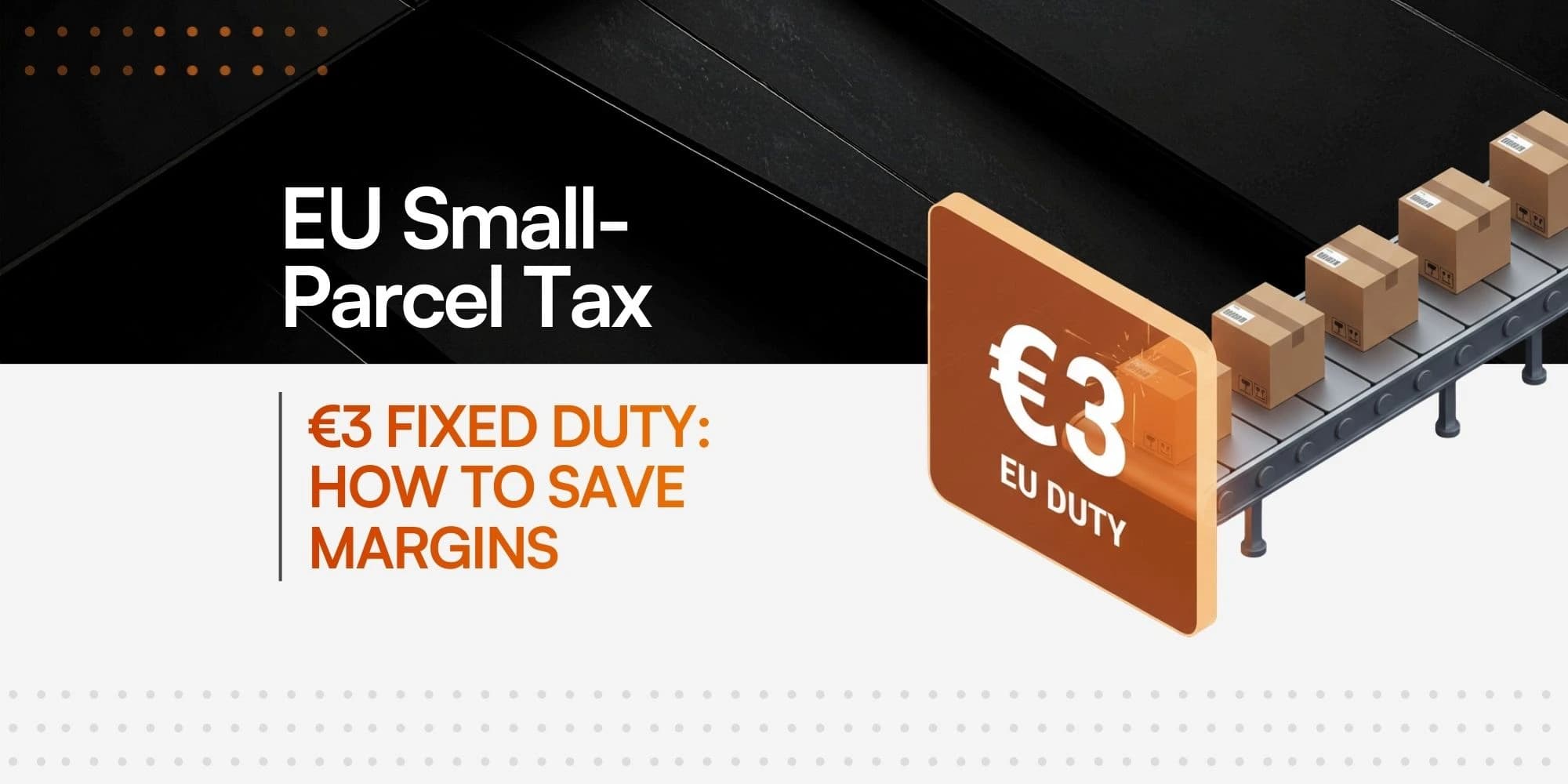
On 11 February 2026, the Council of the European Union approved EU Regulation No. 382. This legislation establishes the abolition of the import duty exemption for goods with an intrinsic value not exceeding €150 sent from a third country, introducing the Union Levy on small-value parcels.
From 1 July 2026, shipments below this threshold will be subject to a fixed customs duty of €3.
It is vital to clarify a frequently misunderstood technical aspect: the amount does not apply to the physical number of items, but rather to each customs line item (product category) contained within the parcel. If a parcel contains five identical products (sharing the same tariff code), the total duty will be €3; if, however, it contains two items from different categories (e.g. a T-shirt and a watch), the duty will rise to €6.
This measure addresses the massive increase in volumes generated by Asian online platforms, which saw 4.6 billion items arrive in the Union in 2024 that were previously exempt from duties. However, this is a transitional measure: the flat-rate duty of €3 will remain in force until 1 July 2028, the date on which the EU Customs Data Hub will officially become operational. From that point onwards, the exemption will disappear entirely, and all goods will be subject to standard ordinary duties calculated as a percentage of the item's value.
Furthermore, the introduction of this fee heavily impacts returns management: the €3 fixed duty paid at the time of import is non-refundable, introducing an unrecoverable fixed cost for merchants in the event of a customer return or cancellation.
At a national level, the picture has long been complex. The coexistence of the new €3 European duty and the €2 Italian fee (introduced in the latest budget measures on non-EU shipments) was considered legally and practically unfeasible.
To avoid an immediate double charge and potential legal disputes, the Italian Government has officially intervened via the Infrastructure decree linked to the National Recovery and Resilience Plan (PNRR), postponing the implementation of the Italian fee until 1 October 2026. Therefore, from 1 July, the EU duty applies exclusively.
However, this move creates a technical issue regarding budgetary coverage for the Italian State. The European regulation stipulates that 75% of the proceeds from the new duty go directly to the EU budget, leaving member states with only the remaining 25% to cover collection costs. As a result, Italy will receive just €0.75 for every mini-parcel imported – a figure a far cry from the €2 entirely national fee originally envisaged in the budget.
Contrary to consumer fears, the duty is not collected from the end customer upon delivery. The legal liability for paying the €3 duty falls directly on online platforms (the major marketplaces), sellers, or carriers submitting the simplified customs declaration (H7 dataset).
To ensure maximum traceability of these flows, the European Union has introduced a data crackdown: while providing Product Identifiers (PIDs) in customs declarations is optional from 1 July 2026, it will become mandatory from 1 November 2026, forcing companies into total customs transparency.
The application of a non-harmonised charge within the single market has prompted many operators to seek loopholes. But how, specifically, is the Italian contribution being bypassed?
In the absence of internal border controls, small-value parcels are first shipped to other European countries where the Italian tax does not exist. Only subsequently is the goods transported into Italy by land. Indeed, figures from the Customs and Monopolies Agency record a 36% drop in low-value parcels arriving directly in the country during the first weeks of January compared to the previous year.
This "workaround" creates a different organisation of supply chains. Routes change not for efficiency, but for purely fiscal reasons, causing delivery delays, an increase in road transport, and a negative environmental impact that contradicts European sustainability goals. For companies, relying on these triangulations means operating in a logistical "grey area," exposing themselves to inefficiencies and poor customer service.

Moving goods within the European Union represents the structural solution to tackle new import duties and severe regulatory instability. Localising e-commerce logistics in Europe allows for the protection of margins and ensures a reliable service.
The measurable advantages include:
Elimination of duties on individual B2C orders thanks to centralised B2B import processes.
Reduced transit times to reach the final customer through shipments handled by local couriers.
Cost certainty at checkout, eliminating unexpected charges for buyers upon delivery.
Lower environmental impact by optimising transport and avoiding logistical inefficiencies and circuitous cross-border routes.
Managing a local warehouse and navigating EU fiscal regulations requires specific expertise and dedicated resources. T-Data supports brands in their international expansion by providing a comprehensive, ready-to-use logistical and administrative infrastructure.
Through its European Merchant of Record service, T-Data assumes direct fiscal responsibility for transactions, ensuring full compliance with EU regulations and managing customs operations at the source. The brand maintains complete commercial autonomy over its catalogue while delegating regulatory complexity, physical transport, and local customer care to a structured partner.