01
August 19, 2026
Outsourcing guide for supplement and haircare e-commerce

Complete guide to selling on the Leroy Merlin Marketplace

Selling on the Leroy Merlin marketplace is a strategic move, allowing you to position your product catalogue directly within Europe's primary home-focused retail ecosystem.
The platform intercepts around 11 million unique monthly visitors in Italy alone, offering merchants immediate access to an audience with high purchasing intent and higher conversion rates compared to generalist marketplaces.
In a sector like home improvement, which is shifting growing market shares towards digital channels, companies operating in DIY, home & garden, and construction will find this platform an essential lever for scaling distribution.
Opening an online shop on Leroy Merlin delivers three direct competitive advantages:
Qualified traffic exclusively focused on domestic and professional project delivery.
Technological stability and seamless integration powered by the Mirakl infrastructure.
Enhanced brand awareness through association with a leading retail banner that protects merchant positioning by enforcing strict quality standards.
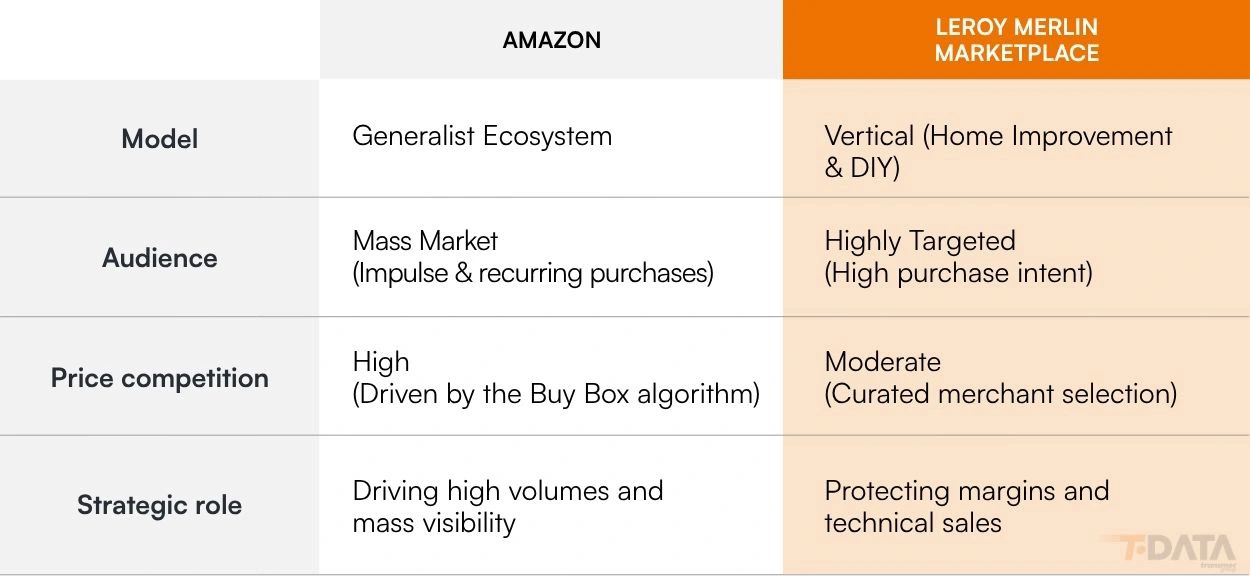
Commercial positioning represents the main difference between the two platforms. Amazon operates as a global, generalist ecosystem characterized by high competitive pressure and strong internal rivalries that often lead to price cutting.
Conversely, the Leroy Merlin marketplace focuses strictly on the vertical home sector.
The primary benefits over a generalist model include a fully targeted audience, the ability to maintain more stable profit margins thanks to curated merchant selection, and the automatic association of your catalogue with the authority of an industry-leading brand. It is a distribution model that rewards technical specialization and product relevance.
Strategic Tip: Choosing Leroy Merlin does not necessarily mean giving up on Amazon. For an established brand, the two platforms are not mutually exclusive; they complement each other. A winning multichannel strategy uses Amazon as the engine to generate high volumes and mass exposure, while positioning Leroy Merlin as the primary vertical channel to safeguard margins and capture high-value niche customers.
The real challenge in this scenario lies in the centralized, seamless management of both channels.
Viewing Leroy Merlin purely as a domestic channel is a mistaken perspective. The brand is part of ADEO Group, the undisputed European leader in the home improvement sector. This means that integrating with the Italian marketplace is not the end goal, but the baseline for launching a digital export strategy.
Key markets such as France (the brand’s home country and a massive market), Spain, Portugal, and Poland generate dominant traffic volumes and are already integrated into the exact same ecosystem. The practical benefit for businesses is technical simplification: the underlying Mirakl architecture is identical across Europe. Consequently, once your catalogue is optimized and tested in Italy, replicating and expanding your sales across foreign portals becomes a virtually immediate process.
Naturally, scaling cross-border introduces customs, logistics, and international invoicing complexities (OSS regime). However, for structured companies pursuing a multichannel approach, European growth potential represents the true breakthrough in terms of revenue.
Leroy Merlin's marketplace is not limited to the final consumer (B2C), but intercepts a significant share of business customers (B2B), often linked to the "Leroy Merlin Pro" programme, such as craftsmen, plumbers, electricians and construction companies.
For merchants, this double channel allows them to diversify sales within the same platform.
While the private customer buys items for DIY and home management, the professional target generates orders with higher volumes and a higher average receipt.
However, receiving orders from both private individuals and companies requires flexible operational management. In fact, it becomes essential to automate electronic invoicing flows for VAT-registered customers and separate the management of retail receipts for final consumers, guaranteeing real-time tax compliance to avoid administrative blocks or delays in shipments.
The high-rotation categories on the platform reflect the historical soul of the brand and intercept the needs of both private individuals and professionals. The main segments include:
DIY and hand tool items
Structural materials for construction and room renovation
Solutions for garden furniture and the care of outdoor spaces
Systems for lighting, heating and energy efficiency
Specialised hardware
Components for home automation

Simply publishing the catalogue on the platform does not guarantee visibility. The marketplace's internal search engine relies on an algorithm that rewards the precision and richness of product data: incomplete or unstructured technical spec sheets drastically reduce impressions and conversion rates.
To optimize the organic positioning of items within the marketplace, it is necessary to meticulously take care of the following factors:
Valid and unique EAN codes: fundamental for the correct indexing of the catalogue and for the native management of product variants (size, colour, format)
Structured descriptive titles: must include the type of item, the brand and the main technical specification, aligning with the real search intentions of users
Fully completed attributes and technical sheets: the detailed entry of data on materials, dimensions and compatibility allows the product to appear when customers use the site's advanced navigation filters
Standard-compliant visual content: high-resolution images on a neutral background, decisive for improving the click-through rate (CTR) in search results and reassuring the user during the purchase phase
The optimal configuration of these elements on high-rotation catalogues requires structured data feed management, an essential element for maintaining competitiveness within the platform.
Access to the platform is selective and not automatic, structured to maintain high standards of service offered to the end customer.
Merchants must satisfy strict parameters:
Be professionals regularly registered with the Chamber of Commerce with a valid VAT number
Propose a catalogue relevant to the product categories approved by the marketplace
Guarantee fast and trackable shipping standards
Provide responsive internal or delegated customer care, capable of managing communications in the local language and effectively resolving post-sales requests
Logistics represents a cornerstone element for operating successfully on this platform. Unlike models that centralize storage, on Leroy Merlin sellers manage shipping and returns directly with dispatch from their own warehouse.
To maintain adequate performance metrics, the merchant must:
Fulfill orders complying with the timeframes declared during the purchase phase
Provide valid tracking codes for each shipment
Independently manage return procedures and refunds
Use software for selling on Leroy Merlin to automate inventory updates via API, avoiding selling out-of-stock products, which would penalise the seller account

The economic model proposed by the platform is based on clear rules. Expenses are divided into two components: fixed and variable.
Monthly subscription: a fixed cost equal to 39 euros (excluding VAT) for the maintenance of the professional account
Sales commissions retained calculated on the total value of the transaction, including shipping costs. Percentages vary in a range between 10% and 15%, depending on the specific product category of the item sold
Selling successfully on a vertical marketplace requires a complex technical and logistical infrastructure. T-Data, as an E-commerce Service Provider, eliminates this operational complexity by managing the entire ecosystem in outsourcing.
Through centralized integration, T-Data resolves the main management and scalability challenges analyzed in this guide:
Technical integration and data feeds: configuration, mapping and updating of catalogues in full compliance with Mirakl architecture to guarantee correct indexing and synchronization of products.
Presence on Leroy Merlin and multichannel coexistence: focus on Leroy Merlin sales flows (also in European markets such as France, Spain and Poland), with the necessary support to make this presence coexist with other already active marketplaces (such as Amazon) and/or the brand's proprietary website in an integrated strategy
Logistics and Customer Care: direct management of the warehouse, fast trackable shipments and responsive customer service in the local language
Tax compliance (Merchant of Record): automation of B2B electronic invoicing for professionals, management of B2C retail receipts and fulfillment of obligations linked to the OSS regime for cross-border sales
This model allows brands to maintain an efficient presence on Leroy Merlin, delegating daily operations to concentrate internal resources on product development.